An Introduction:
It is within these pages that you can locate my attempts at translating some of the texts that I came across with along the way. While it can be, at times, pretty difficult to undermine some excerpts of the older texts, the act of translation remains to be one of my favourite activities in philology. It is where an individual’s imagination leaps genuinely to life and tries to submerge themselves into the very shoes of the original author. The distance in age grows not only in number of years but also in fashion and concepts. By translating your texts, you will soon come to realise that yours shall vary from other ones, and this is a phenomenon which is not peculiar to the field of philology. I remember how one philologist mentioned and compared an array of multiple translations and came to the quick conclusion that philology will never have a ‘definite’ form; since every individual will have another perception and interpretation to the text that is represented to them. The main problem with philological reasoning is that we do not have any living native speaker prowling about the earth to tell us whether our interpretation of a translated piece of text is correct or not. Furthermore, if we even had such an individual among us, it would still be a pleasant game of blowing in the wind for everyone’s interpretation may slightly differ from the author’s intention. This slightest deviation in meaning may then cause for an entire different reading and experience. There is a good reason why modern people still speculate and publically debate about a song’s (or any other artful expression) supposed meaning. Christopher Tolkien summed up and wrote about such an equal situation:
‘The translation was completed by 1926, when my father was 34; before him lay two decades as the professor of Anglo-Saxon at Oxford, two decades of further study of Old English poetry, together with an arduous programme of lectures and classes, and reflection most especially on Beowulf. From his lectures of those years there survives a great deal of writing on the poem, including much on the interpretation of the detail of the text. Clearly, there was no step-by-step relationship between the lectures and the translation, but changes made to the translation (and there are many) at different times can often be seen to accord with discussion of the questions in his lectures. In other cases, he did not alter the translation in the light of his later, revised opinion’ (Tolkien, C., Beowulf: A Translation and Commentary Together With Sellic Spell By J.R.R. Tolkien; Edited by Christopher Tolkien, HarperCollins Publishers, 2014).
The Fox and the Wolf translation is a way to celebrate this year’s easter!

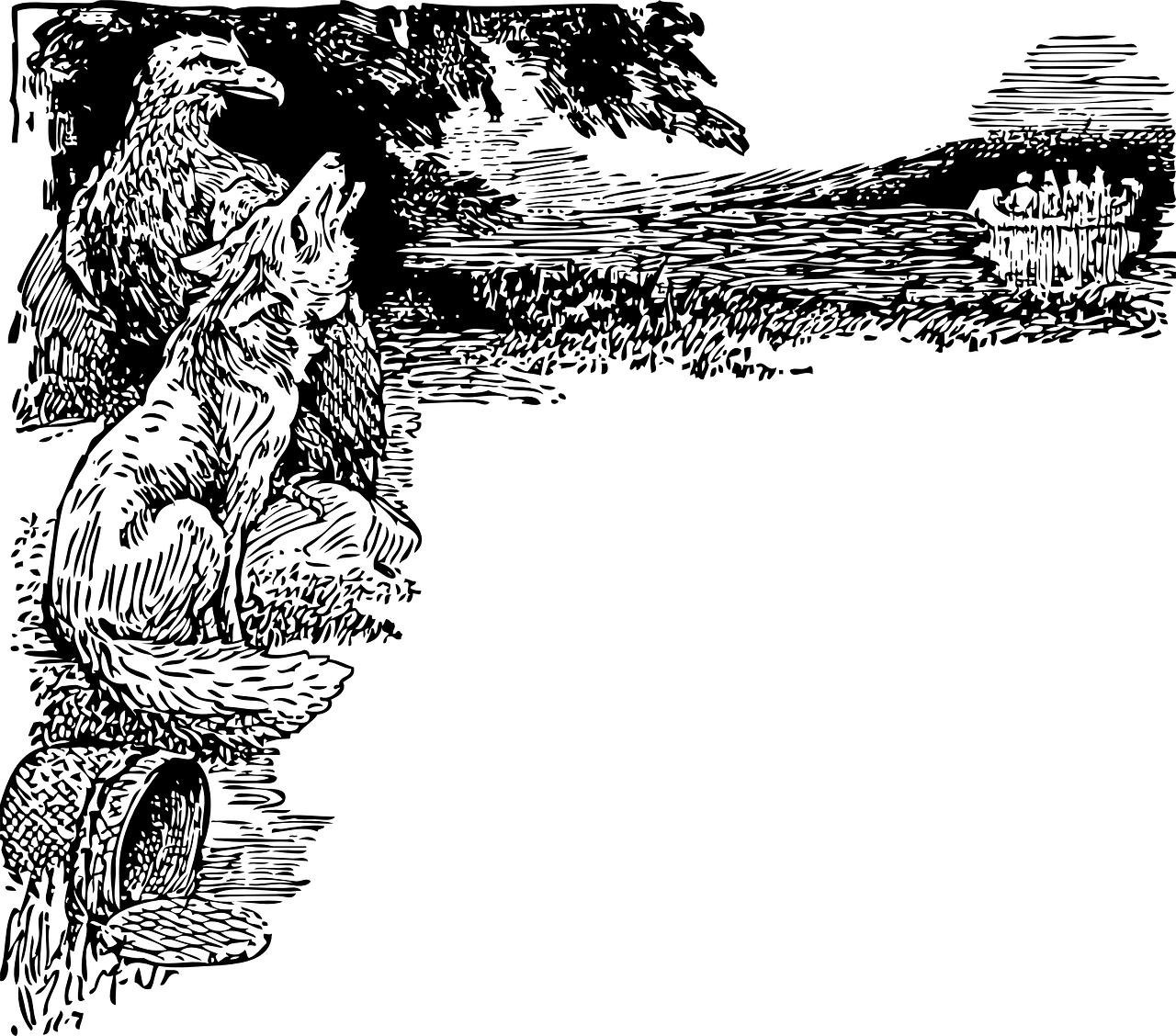
The Fox and the Wolf found at Oxford, Bodleian Library, Digby 86
The translation to Present Day English is provided by yours truly,
N.A.M. Oosterlee.
A fox came out of the woods and left,
It was hunger that made him sorrowful;
He never knew half as much hunger,
As this before.
He held to neither way or street,
For he was loathful to meet men;
He preferred more to meet one hen,
Than half a hundred women.
He swiftly made his way overall,
So that he caught sight of a wall;
Within this wall, there was a house,
Where the fox was eager to go to,
For he thought that it would satiate his hunger,
Full of drinks and food.
When he came about, he well-eagerly beheld it;
Although passionate, it was only then that the fox began to run.
During his sprint, he stumbled upon one wall,
Some of its bricks were ruined and fallen off,
And the entire wall was left destroyed,
And upon that, there was a lock.
At the first breach that he found,
He lept in and went over it.
As he made his way in, he scornfully smirked,
And from there, he enjoyed great entertainment:
For he came in without taxes,
Both are not given by either hedge-keeper or reeve.
There was a house there, where the door stood ajar,
Hens had crept in,
There were at least five, which made quite the flock,
And with them, there sat a cock.
And the cock was then flying on the hay,
And two hens were sitting near him.
“Fox!” yelled the cock, “What are you doing there?
Go home, Christ will bestow sorrow on you.
Our hens are often caused harm by you.”
“In God’s name, I order you to be still!”
Returned the fox, “Sir Chauntecler,
You must fly down and come near me.
I have done nothing here but good:
I have only let the hens bleed;
who were already sick under the ribs,
that they might not have had much time to live,
But here I took their life-blood,
which I did for everybody’s sake.
I let their poisoned blood be mine,
And you, Chauntecler, it would do them good.
You have it that each one has got it under their spleen,
You will never survive ten days:
For your living days are almost nigh to cease,
But you can be saved unless you will heed my advice.
I will let fortunate blood flow under your breast,
“Go away!” said the cock, “let you be covered by woe!
You have done ill against our family.
Go with what you now have;
Let God’s might accurse thee!
For when I will be down, by God’s name,
I am sick of your confidence.
But our steward shall know about this,
That you came here,
He shall soon go after you then,
Carrying with him pikes, stones, and staffs strong.
He shall break all the bones in your body;
then we shall be avenged!”
The fox was mute and did not speak anymore,
But a thirst was working up in him.
The thirst brought him sadness,
Even more than his hunger had before.
He went all places looking:
As it happened, there was one well with water,
His mind took him on an adventure there,
which was done with great skill.
He found two buckets there,
and one dropped to the ground.
People still blame me for that wind-up,
that the other bucket went up and down.
The fox did not comprehend the device’s skill,
He took that bucket and lept into it,
For he hoped to drink in it.
The fox realised that he was too late,
as the bucket began to sink,
and he was trapped within its mechanism.
Within the bucket, he began to think for himself,
But it did not help at all against the device;
Still stuck in the bucket, he needed to go down,
He was treacherous with his deceitful game.
It might have been from out of his own will,
that the bucket hung still.
By sorrow and dread,
All of his former thirsts ceased.
It was then that he landed on the surface,
and it was there that he found some water.
When finding the water, the fox eagerly consumed it;
He forgot how the water reeked,
For it was against his will!
“Worthy of woe!” the fox said, “will and lust,
that knows nothing about the balance of food.
If I never had eaten too much,
I would not have been in this shame now,
No, I am the lust of my mouth.
He is the woe in each land,
that his death with his hand;
I am treacherous with my deceitful game,
For some devil brought me here.
I was supposed to be a wise one,
but now I do not have it in me anymore.”
The fox wept and misery began;
It was then that a wolf appeared,
He remained out of the deep wood,
For he was also hungry.
He had found absolutely nothing throughout the night,
Nothing that would satiate his hunger.
He walked by the well and heard the fox speaking,
He immediately recognised his voice, for he knew him well,
it was his neighbour,
And he was the godfather of his children,
Down the well, he then sat.
The wolf then said: “What might it be
that I hear in the well?
Are you a Christian or are you my friend?
Tell me the truth, by not telling any lies,
Who had put you into the well?”
The fox well-recognised his kin,
And that alone gave him an idea;
For he thought with some ingenuity,
He thought to switch positions with the wolf.
The fox said then: “Who is there now?
I know that it is Sigrim who I am hearing!”
“That is true!” The wolf answered.
“As God is your guide, what are you?”
“Ah!” spoke the fox, “I want to tell you,
On my word, that I will not tell you a single lie,
I am Reneuard, your friend;
And your coming was expected by me,
I had prayed for you,
That you would come to me!”
“Come to you?” The wolf replied, “Where to?
What should I be doing in a well?”
The fox responded then: “You are kidding,
Paradise’s bliss is here:
It is here where I may ever fare heavenly,
Without pain or torment;
Food and drinks are here,
It is bliss without any stress of labour;
You will never know of any hunger here,
Nor any other types of sadness;
for all that is good is down here!”
With each passing word, the wolf laughed:
“Are you on another planet, as God is your guide,
are you dead?” the wolf asked.
Then the wolf said: “When did you die?
And what are you now doing there?
It has not been three days ago,
since I last saw you and also your wife,
And your children, great and small,
You were all eating together with me.”
“That is correct,” the fox answered,
“Thank God, it is now, thus,
that I am to come to Christ;
It is not any of my friends that know.
For all the world’s good, being in that world,
it is where I found them.
Where in the world should I go to?
Where there is only woe and sorrow?
And live in sin and filth?
But here you can enjoy many joys,
There are both sheep and goats found here.”
The wolf had immense hunger,
For he had not eaten for a long time,
And when he heard of food,
He wanted gladly to be there.
“Ah!” said the wolf, “God’s companion,
You had taken away many of my good meals,
Let me come down to you,
And then I shall forgive you.”
“Yes,” said the fox, “you have been absolved,
And your sins have all been forsaken,
And I take your life to clean it,
I want to ask you,
That you should come to me.”
“To whom should I,” the wolf answered,
“Know that I have confessed for my sins?
Here, where there is nothing alive,
That I now can be absolved.
You have often been my friend,
Do you now want to hear my confession?
And should I tell you all about my life?”
“No,” replied the fox, “I don’t want to.”
“You don’t?” the wolf asked, “Have your mercy,
I am in great distress because of hunger;
I know that by tonight I will be dead,
However, you could give me some assistance.
For Christ’s love, I want you to be my priest.”
The wolf bowed down his breast,
And began to sigh hard and vigorous.
The fox then asked: “Do you want to receive confession?
I want you to continue to tell of your sins,
That your faith is never omitted.”
“Soon,” answered the wolf, “Well, bite me!
I have been wicked throughout my entire life:
I have received a widow’s curse,
Thus, I am bound to sail horrendously.
I have devoured a thousand sheep,
And even more than there have been recorded,
But it is I who repents bitterly.
Lord, do you want me to tell more?”
“Yes,” the fox responded, “you must tell everything,
Or else you must pay for it.”
“Godfather,” said the wolf, “please forgive me,
I have often said wicked things towards you.
But people told me that during your life,
You have misbehaved with my wife:
I had observed you on one occasion,
And I found you both together in bed.
I was often very near you,
And I saw you two together in bed.
I considered, as others also do,
that what I saw was the truth,
And, thus, you became my loath.
Good godfather, you should not be angry with me.”
“Wolf,” said the fox there to him,
All that you had and did before, I shall expel it,
In thought, speech, and deeds,
In each other evil being,
I shall forgive thee in this dire time of need.”
“Let Christ reward thee!” the wolf exclaimed,
“I now have a cleansed life,
I do not have any care for my wife and children anymore.
But tell me what I should do now,
And how do I come and reach you?”
“Yes?” the fox responded, “I want to teach thee.
Is your bucket hanging there?
There is an opening of Heaven’s bliss,
You must for certain leap in there,
And then you should soon arrive to me.”
The wolf answered: “That is fairly easily done.”
He jumped in and made a great deal of distance:
That the fox knew quite well.
For the wolf sank and the fox rose,
At that time, the wolf began to feel afraid,
As he came to the middle of the well,
The wolf met the fox upward.
“Friend,” the wolf replied, “What do I do now?
What do you have in mind? Where do you want to go?”
“Where do I desire to go?” the fox answered,
“By God’s divine interventions, I want to go up,
And now go down with your bucket,
the profit of your fall is small.
But I am, thus, glad and satisfied,
That you have taken a cleansed life.
I shall ring the death knell,
And there shall be held a singing mass for your soul.”
The creature could find nothing beneath,
But cold water and hunger bound him.
To a cold feast, he was going to bed,
Frogs had his dough kneaded.
The wolf stood in the well,
He was mad out of hunger.
Within it, he cursed any being that brought him there:
The fox cared little about that.
The well was near his home,
some friars lived fairly craftily there.
As it came to be time,
for them to arise,
For the fox sought out their houses.
From their sleep, they needed to awaken,
There was a friar among them,
he needed to go to stretch out.
He yelled, “Arise, everyone!
And come to do the domestic matins.”
This same friar was called Ailmer,
He was their master gardener.
Right in the middle of the house’s song,
he was having a strong thirst.
He then went alone towards the well,
For he required some remedy.
When arriving at the well, he drew the bucket up,
And the contained wolf made it heavier.
The friar attempted with full might to pull it up,
As long as he saw the wolf.
For he saw the wolf sitting there,
He cried out: “The devil is in the well!”
Armed with pikes, sticks, and stones,
the friars went over to the well,
each man was carrying something,
Woe was he who did not hold a weapon.
They arrived at the well and pulled the wolf out,
Then they headed over for vengeance towards the enemy of their sheep,
that were eager for them to chase him down,
with great hounds and to beat him.
Well and angry, the wolf was beaten,
With sticks and spears, he was stabbed.
The fox had deceived him for certain,
For he never found any bliss like this again,
Nor had of blows for forgiveness.
The End.




 N.A.M. Oosterlee