By N.A.M. Oosterlee, The Medieval Skald, Blog Entry IV

“787
Her nom Beorhtric cyning Offan dohtor Eadburge: ⁊ on his dagum cuomon ærest .iii. scipu, ⁊ þa se gerefa þærto rad, ⁊ hie wolde drifan to þæs cyninges tune þy he nyste hwæt hie wæron; ⁊ hiene mon ofslog; Þæt wæron þa ærestan scipu Densicra monna þe Angelcynnes lond gesohton” (The Anglo-Saxon Chronicle A, Parker MS: Corpus Christ College, Cambridge MS 173 ff. 1-32, ).
During this year, King Beorhtric took as his wife Eadburh, the daughter of King Offa, and in their first days arrived three longships, and the reeve rode up to meet them. Upon the reeve’s arrival, they asked for the location of the king’s town for they did not know where they were. The reeve was then slaughtered. This was the first time that Danish ships sought out English lands.
As ordinary as it has been portrayed here, it almost reminds me of H.G. Wells’ The War of the Worlds (1898): “Yet, the next day there was nothing of this in the papers except a little note in the Daily Telegraph, and the world went in ignorance of one of the gravest dangers that ever threatened the human race”. Anglo-Saxon England stood at the brink of centuries exchanging wars against Scandinavian troops. Their opponents were a side that changed drastically over history: from a simple gang of pirates committing local theft to great gathered armies ready to conquer territories. In this blog entry, I would like to look at the earliest attacks of the Scandinavians. What drove them out to the open seas and made them plunder?
Krákumál
Anybody who has seen the History Channel’s television series Vikings may have been exposed by their narrative’s protagonist Ragnar Loðbrok, who is played by Travis Fimmel, and his ‘discovery’ of England. The actor’s character is based on someone whose existence remains vague and unclear. Some written sources speak of a Ragnar who seems to fit the bill for his account of existence. However, they do not indicate anything related to the Lindisfarne raid of 793, making it unlikely that the real Ragnar fought and plundered alongside these men. Another source which will provide no participation of him is the revenge of his ‘sons’ during the Great Heathen Army’s conquest of England (865 A.D.). It is believed that Ragnar’s sons were there to avenge his death:
“All the sons of Áslaug would now wish to start a battle here with sharp swords if they knew the full story of the treatment I am receiving: how numerous poisonous snakes are tearing at me. I gave my sons such a mother that their hearts stood firm” (McTurk, 2017).
This would leave us then with a period of seventy-two years (and count along with it his grown age at the events of Lindisfarne) where a supposed Ragnar would have lived. If there was a historical Ragnar Loðbrok present in the timeline, we must rely more on the sources that have more quantity to his topic, which are his sons’ lives. Although some still deem the historical truthfulness of figures like Ívarr ínn Beinlausi (Ivar the Boneless) and Bjórn Járnsíða (Bjorn Ironside) a mere product of Germanic epic imagination, there are some mentions of the two legendary Nordic heroes in contemporary works. The former is largely present within the literature of mid-ninth-century Irish annals. However, his name was a subject which often tended to change in orthography. The Anglo-Saxon Chronicle mentions an Inweres (annal 879), whereas an Ímair appears to us in Irish manuscripts. As mentioned in my previous blog entry, this is not surprising since most medieval writers wrote their spelling phonologically: not to forget that both were completely different languages. While Ragnar and his proclaimed offspring have fascinating tales to talk infinitely about, they will not suffice in telling much about the earliest Scandinavian attacks.
Lindisfarne: Domesday and Dragons
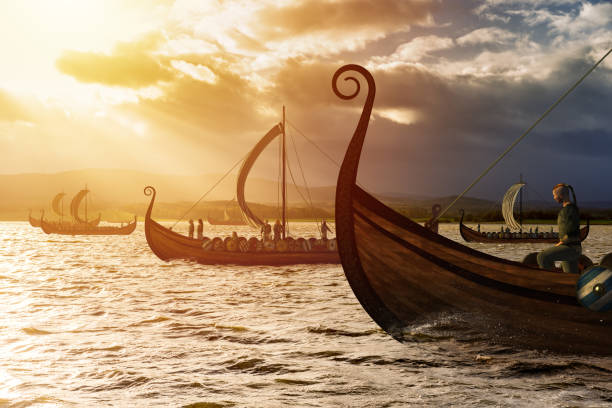
Once granted by King Oswald, the first Christian king of Northumbria, in the year 634 A.D., the holy island of Lindisfarne was one of the most important and sacred Christian institutions in England. Within its vast halls, it was for a long time in Anglo-Saxon England inhabited by Christian clergy who were there through education and to document and preserve sacred texts. The Anglo-Saxons had finally enjoyed an age full of learning and prosperity until:
“AN.dccxciii. Her wæron reðe forebecna cumene ofer Norþanhymbra land ⁊ þæt folc earmlice bregdon: þet wæron ormete ligræscas, ⁊ wæron geseowene fyrene dracan on þam lyfte fleogende. Þam tacnum sona fyligde mycel hunger, ⁊ litel æfter þam þæs ilcan geares on .vi. idus Ianuarii earmlice heðenra manna hergung adiligode Godes cyrican in Lindisfarenæ þurh reaflac ⁊ mansleht” (The Anglo-Saxon Chronicle Manuscript E).
793, during this year, terrible prophesies hovered over the land of Northumbria, and brought misery upon its people: there were overwhelming lightning bolts, and there were fire-spewing dragons spotted flying high up in the air. Much hunger was soon following these signs and little after that came the attack of heathen men against God’s church on Lindisfarne during that same year on the 8th of January bringing plunder and manslaughter.
After this devastation of Lindisfarne’s monastery, the Anglo-Saxon world would now reside in the ‘gruesome’ Viking age until roughly the Norman takeover from 1066. This period can be coined as one of clashing cultures; the ancient ways were fiercely tested out by the new and vice-versa. Although the Anglo-Saxons defined every Scandinavian as a malign ‘heathen’, and seemed to disapprove of any motion coming from them, many people forget the fact that the Anglo-Saxon people did not vary much from Scandinavian society a few centuries earlier:
“If their native state sinks into the sloth of prolonged peace and repose, many of its noble youths voluntarily seek those tribes which are waging some war, both because inaction is odious to their race, and because they win renown more readily in the midst of peril, and cannot maintain a numerous following except by violence and war” (Tacitus, Germania, 98 A.D.).
There must be the notion that this quote derives from an enemy of the Germanic lands. However, I want to demonstrate why this particular manner of conduct can illuminate the behaviour of the ‘sudden’ offence against England. According to the Venerable Saint Bede’s Historia ecclesiastical gents Anglorum, one of the major reasons why the Germanic tribes sailed over the ocean and colonised Celtic Britain was: “How the Angles, being invited into Britain, at first drove off the enemy; but not long after, making a league with them, turned their weapons against their allies” (Sellar, 1907).1
By demonstrating this passage, I want to stress that the Anglo-Saxons were at first, according to Venerable Bede, mercenaries who were hired to withstand any incoming attack from the marauding Picts from the north and defend the Brythonic people. The latter had asked the pope for any support for their cause. Unfortunately, the year was 449 AD, the same year, when war broke out between large areas of the European Continent and Attila the Hun’s armies. Another two years later, Rome would meet them at the infamous ‘Battle of the Catalonian Plains’.2 After receiving a negative reaction to any aid from Rome, the Brythonic war chiefs turned towards one of their last resorts: the ‘Barbaric’ people across the pond. As the first few warmongering tidings turned out to be a success for the Anglo-Saxon side, they started to feel a sudden ‘burden’ to remain in Britain and take it swiftly over from the native people’s hands; for they were deemed too weak to protect Britain. The Bretons never anticipated what followed and, as the Red Wedding of Game of Thrones, they were gathered at a feast to be struck down surprisingly by a band of Anglo-Saxon warriors. This is an excerpt from one of the recorded Anglo-Saxon attacks: “For a long time, these mercenaries were granted regular, monthly supplies (Gildas uses three specific Latin terms: epimenia, annonae, and munificentia). Soon, they found that these were insufficient and, exaggerated tensions over individual ‘incidents’, threatened to mutiny. Mutiny turned to plunder; towns were laid low; fires licked across the land as far as its western shores. There was no burial to be had except in the ruins of houses or the bellies of beasts or birds” (Adams, 2021).3 By examining how the later Anglo-Saxon clergies wrote about the ‘heathens’ and their movements, I cannot help but see a linear pattern arising between the two cultures.
The Germanic Manner of Seeking and Maintaining Alliances
The world of Beowulf, which is found in the Nowell Codex manuscript at the British Library, is one serving as an epitome in giving a potential indication of how the ancient Germanic world was in its social constructions. The epic story’s Geatish protagonist hears about the Danish struggle against the monstrous entity named Grendel. This ‘hearing’ is not the only reason the hero embarks towards the shores of Daneland; for his father had established a socio-interrelationship after King Hrothgar of the Danes helped Beowulf’s father out. With his undeniable thirst for honour and glory to his name, Beowulf is determined to further knot ties with King Hrothgar by accepting the king’s proposal of Grendel’s discarding. Even after Beowulf succeeds in slaying Grendel, he is again bestowed with riches by King Hrothgar; reforging yet another ongoing cycle of vowing allegiance to one another. The French sociologist M. Mauss wrote about such custom in historical societies: “What imposes obligation in the present received and exchanged, is the fact that the thing received is not inactive. Even when it has been abandoned by the giver, it still possesses something of him. Through it, the giver has a hold over the beneficiary” (Mauss, 2000).4 An equal situation, but then it serves as the protagonist’s yearning for it, is found in the Old English elegy The Wanderer in the Exeter Cathedral Library MS 3501:
Hwær cwōm mearg? Hwær cwōm mago? Hwær cwōm māþþumgyfa?
Hwær cwōm symbla gesetu? Hwær sindon seledrēamas?5
When transgressing theories of phrasing the Germanic and Scandinavian cultures as heterogeneous from one another, it is then that we could establish a new theory on the Viking raids of the late eighth century. As mentioned above, the Anglo-Saxons were once mercenaries who provided their shields and spears as an exchange service to ally with another ‘clan’: “The distribution, sharing, and bestowal of these treasures create something we might call a social economy of honour, worth, status, and loyalties” (Hill, 1995).6 While examining the Anglo-Saxon Chronicle, there is a rather rough period of conflicts around the year of the first recorded Viking activity. Within Manuscript Versions A to E, all tend to tell about a fight between the campaigns of King Offa of Mercia and King Cynewulf of Wessex in the year 779 AD. The latter is essentially murdered in a surprise attack by one of his former noblemen in 786 AD. King Offa of Mercia is, at that moment in time, the mightiest Anglo-Saxon king having the entire South and by marrying both his daughters to both the kings of Wessex and Northumbria also having these parts under his influence. His power is so well-esteemed that even the ‘great’ Charlemagne notices and acknowledges the king’s worthy presence across the sea.
All of this prestige and wealth must have attracted other individuals as well. After taking in the dating and framing of British objects found in some Scandinavian graves in Norway, there have been proposed three-dimensional preluding stages before the raid of Lindisfarne: an information stage (750-770 AD), an environmental learning stage (770-790 AD), and the earliest recorded raids (from 793 AD onwards). A.M. Heen-Pettersen suggested the following: “…Viking attacks were only possible after a phase in which Norse seafarers had acquired the necessary level of a priori environmental knowledge needed to move in new seascapes and coastal environments” (Heen-Pettersen, 2019).7 By voyaging through a new and unknown maritime world with higher risks of danger than safety, these Norwegian travellers allude to being cautious in their every impending move across the waves. Unsurprisingly, the first recorded attacks were raids that targeted peninsulas off the coast of the British Isles for they were a hit-and-run without any possibility of interference from the mainland. Why did they attack one of the most sacred Anglo-Saxon monasteries as an ignition point? This can easily be answered by introducing the successful art of psychological warfare and a society’s mass fear. In modern times, the fear of nuclear bombings is, once again, holding any nation from indulging in war with either Russia or the West. The Scandinavians must have known about the importance of the Lindisfarne monastery towards the Anglo-Saxons. The different English kingdoms have been at war for decades, and the Northmen must have known that their violence would be deemed as ‘severe’ and ‘serious’ if they pillaged Lindisfarne. Afterwards, the Scandinavians would be transformed into God’s wrath upon the English people. This specific clerical classification is one of the many propagandas the Christian church utilised during these times: the Christian (Miles Christi: soldier of Christ) versus the pagan.
Conclusion
The Northmen were a newly introduced brutal force in the late eighth century in the British Isles. As a culture, they were not essentially different from the Anglo-Saxons, and they shared many cultural features which would make them hard to differentiate. The main cultural distinction would have been their religions. When the Anglo-Saxons were converted to Christianity, the Scandinavians still upheld their faith in the Germanic gods; a religion formerly abandoned by the Anglo-Saxons. Whether it has to do with the Christian Church documenting these historical events, Christianity served as the main point of exploitation either in using it as a tool of fear or in framing the Scandinavians as the antagonistic ‘heathens’. My wonder remains what would have happened if the two were both still believers in Odin, at that time. Would it then be possible to separate an Anglo-Saxon from the Norse?
Works cited
Adams, M., The First Kingdom, Head of Zeus Ltd, 2021.
Allard, J., & North, R., Beowulf and Other Stories: A New Introduction to Old English, Old Icelandic, Anglo-Norman Literatures, Longman Div of Pearson, 2011.
Baker, P.S., Introduction to Old English, Third Edition, Wiley-Blackwell, 2012.
Heen-Pettersen, A.M., “The Earliest Wave of Viking Activity? The Norwegian Evidence Revisited”, European Journal of Archaeology 22, p. 523-41, European Association of Archaeologists, Cambridge University Press, 2019.
Hill, J.M., The Cultural World of Beowulf, University of Toronto Press, 1995.
Mauss, M., The Gift: the Form and Reason for Exchange in Archaic Societies, translated by W.D. Halls, W.W. Norton & Company, 2000.
McTurk, R., “Samuel Ferguson’s ‘Death-Song’ (1833): An Anglo-Irish Response to Krákumál, Constructing Nations, Reconstructing Myth Vol. 9, pp. 167-91, Brepols Publishers, 2007.
Sellar, A.M., Bede’s Ecclesiastical History of England; a Revised Translation with Introduction, Life, and Notes by A.M. Sellar, George Bell & Sons, 1907.
Tolkien, J.R.R., Beowulf: A Translation and Commentary, Edited by C.J.R., Tolkien, HarperCollins, 2014.
Wells, H.G., HG Wells Classic Collection I: The Time Machine, the Island of Doctor Moreau, the War of the Worlds, the First Men in the Moon, the Invisible Man, Gollancz, 2010.
- Sellar, A.M., Bede’s Ecclesiastical History of England; a Revised Translation with Introduction, Life, and Notes by A.M. Sellar, George Bell & Sons, 1907. ↩
- According to historical records, this battle stands out for being the only time that Attila’s forces were ever beaten. ↩
- Adams, M., The First Kingdom, Head of Zeus Ltd, 2021. ↩
- Mauss, M., The Gift: the Form and Reason for Exchange in Archaic Societies, translated by W.D. Halls, W.W. Norton & Company, 2000. ↩
- Baker, P.S., Introduction to Old English, Third Edition, Wiley-Blackwell, 2012.
Translation:
“Where has the horse gone? Where has the man gone? Where have the treasure givers gone? Where has the place of banquets gone? Where are the pleasures of the hall?”. ↩
- Hill, J.M., The Cultural World of Beowulf, University of Toronto Press, 1995. ↩
- Heen-Pettersen, A.M., “The Earliest Wave of Viking Activity? The Norwegian Evidence Revisited”, European Journal of Archaeology 22 (4), European Association of Archaeologists, Cambridge University Press, 2019. ↩

 N.A.M. Oosterlee