By N.A.M. Oosterlee, The Medieval Skald, Blog Entry II
In the conclusion of my first blog entry, I left the implication that I will be examining and testing a contemporary theory of mine in this blog episode. This train of thought first occurred to me while I was reading through Marie de France. The idea was that her plots appear to resemble some of the literary narrative features of the later Gothic genre. As it piqued my interest, I desire to examine whether there are traces of the Breton Lay found within the Gothic genre or not. Are the sharing tropes of the supernatural, the sublime, hubris, and terror sufficient to call the two distinctive genres close relatives solely separated by the centuries?
What is Gothic Literature?

Whether you love or despise the act of reading literature, I think that almost anybody in the United Kingdom has heard of a creepy figure who embarked on a journey from his homeland of Transylvania to set sail out to the teeming streets of good old London Town to wreak havoc there: Count Dracula. If the Count and his horrid adventures do not ring any bell then perhaps the Monster created by the proud Swiss natural science student Frankenstein will do this for you. As a literary genre, the Gothic remains one that someone can praise or hate for its enigmas and plot-wrecking twists. While many Gothic titles are still ranked amongst the highest rankings of English literature of all time, the literary genre also received a lot of critiques for its design and, in particular, its authors and readers:
“Silly novels by lady novelists are a genus with many species, determined by the quality of silliness that predominates in them — the frothy, the prosy, the pious, or the pedantic. But a mixture of all these — a composite order of feminine fatuity- produces the largest class of such novels, which we shall distinguish as the mind-and-millinery species” (Eliot, 1856).1
While not directly implying the Gothic in her statement about contemporary Victorian English novels, it can be easily deducted that she is probably referring here to Gothic novels and novellas, since this moment preludes the dawn of Darwinism (1859) and further ‘earthly’2 scientific development. The reason why I am correlating, especially, the Victorian Gothic novel with actual science has to do with the fact that: “The Gothic genre is known to use transgressions and bring repressed feelings and thoughts to the surface” (Olschewski, 2021).3Thus, within a time, when the Western world was exploiting the Earth with scientific analysis to its very core, you can imagine that a Victorian novelist would fully spoil the unlimited aspect of one’s fantasy, which the Gothic genre offers them. Being so narrowly bound towards one’s inner feelings and thoughts, the Gothic genre can allow the writer to experience in-depth horror and fears; which can contribute to an ‘intense’ narrative style.
But What has Gothic to do with the Middle Ages?

“PERHAPS MORE THAN any of the other art forms explored in this book, the category of ‘Gothic sculpture’ and what comprises it is contingent upon the meanings mobilised by the term ‘Gothic’ itself. If, in accordance with certain eighteenth-century uses of the word, ‘Gothic’ is taken to signify what we now refer to as the ‘medieval’, or that which the OED refers, first and foremost, to the figurative and decorative religious sculptural forms that were fashioned to adorn both the interior and exteriors of the medieval or ‘Gothic’ cathedrals of Britain and Europe during the twelfth, thirteenth, fourteenth, and early fifteenth centuries” (Lindfield & Townshend, 2019).4
Thus, according to them, the meaning of the word ‘Gothic’ is a mere synonym for resembling late-medieval fashion design in their sculptures and buildings. Lindfield and Townshend also take the reader back to the first English Gothic novel and its author: “…it was in Walpole’s extraordinary literary experiment in The Castle of Otranto (1765) that his medieval sculptural tradition underwent a radical cultural transformation, as the epithet ‘Gothic’ that was appended to the subtitle of the second edition of Walpole’s fiction eventually came to signify in its wake a sense of the marvellous, the supernatural and the ghastly, the term, thus, gradually assuming the meanings that it most often carries in literary and cultural studies today” (2019). If we are to take this specific individual responsible for our current comprehension of the Gothic literary genre, then it would not be very surprising why we associate it with the Middle Ages; for the man’s habitat was a reconstructed castle moulded and shaped from inspiration drawn from “gothic vaulting, medieval tombs, and rose windows”.5
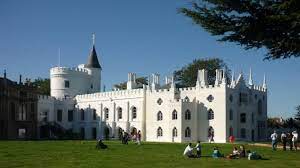
Copyright of photograph: strawberryhillhouse.org.uk
Social Deviance, Anxiety & Desire
When examining both periods, Anglo-Norman England and the Gothic Revival period were both times when there was a disruption occurring within society. In Anglo-Norman England, the entire land’s politics and regime were swiftly being run over by a foreign enterprise. During the Gothic Revival period, Western society saw their ‘modern’ technology rise to unprecedented heights. Social deviance is a term which I used in this subtitle. As a broad psycho-sociological concept, it bears various meanings. The one that I am aiming for is: “…behaviours or attributes that conform to the expectations of one group but violate the expectations of another group from whose perspective the judgement of deviance is made” (Kaplan & Tolle, 2006).6 It is the process that occurs when there is friction between bands of people in a society, which often then leads towards the increasing amounts of subcultures in that society. The reason why I am connecting this social phenomenon towards both periods is that I can imagine that within these societies there were lots of different opposing voices. This is a social effect which can be marked down towards any human generation. However, I think that at some times, like the Breton Lay and Gothic Revival periods, there are such extremely contrasting oppositions, that the need arises to convey your ‘voice’ through forms of art. The Breton Lay and Gothic are both products which are frequently linked to the act of nationalism. I am not referring here to the radical term, but more to the feeling of wanting to perceive recognition while you are set in a place that seems ‘foreign’ to you. It is the hunger to catch that sense again that brings you back ‘home’. In both situations, there was a social clash of events, for instance, in the Gothic Revival period with their ‘British’ nationality:
“Renaissance thinkers held up for emulation the classical traditions of Greece and Rome while tending to associate the Middle Ages with primitivism, superstition, and the domination of the Roman Catholic Church, which English writers increasingly claimed was anti-English… and borrowed freely from the Middle Ages for both artistic and political ends” (Simmons, 2011).7
Returning to one of my previous blog entry’s quotes, the final sentence of Marie de France’s introduction is: “Marie ai nom, si sui de France” (My name is Marie, and I am from France).8 As I was stumbling through my university life this week, her final words awakened many different thoughts and considerations in me. Not only, because she has revealed herself to her audience, but, too, that she explicitly mentions to them that she is from France. Why, and when, would someone specifically do this? After many hours of contemplation, I am left with two possible scenarios, and they both are in a paradox of each other:
- She wanted to be completely disassociated from anything that resembles “Englishness”, and by referring to her French identity, she felt inclined to let her audience know this ‘separation’ from the Anglo-Saxons. She feels like an outsider to them.
- She was in between worlds of the English and French people and cultures and felt the dire need to state her French identity as a means of ‘loyalty’ to her former land.
This second possibility arrived to me when I was reconsidering her recurring topic of the commitment to adultery in her various stories. This is all hypothetical but what if she self-portrayed her current position between two nations to her characters’ love affairs? What if love, service, and loyalty to one’s country are the same as any other love relationship?
“Medievalism”
When reviewing the Gothic literary genre on origin and etymology, the presence and link towards the Middle Ages appears to be a common tendency. However, while it may be interrelated towards the period, it does not mean that it is. The Gothic Revival period will always be known as being a mere adaptation of the Middle Ages with only grasping a few minor slices of the entire ‘medieval cake’. Although I separate them there, it does not mean that I do not see striking similarities between the two literary genres. These shared characteristics are mainly drawn from the fact that both genres seem to be aimed at preserving conservative traditions in their style of plot writing. The Breton Lay suggests to have come from the ancient Celtic poetic tradition, whereas the Gothic shows a desire to remain bound to the supernatural and folklore of the Middle Ages. Both are invoking their ancestral right to compose their lines of literature. I think that Matthews demonstrates their difference perfectly well in the following two lines of his Medievalism: a Critical History:
“On the one hand, in the modern news story, there is what we can call a gothic or grotesque Middle Ages, entailing the assumption that anything medieval will involve threat, violence, warped sexuality (conversely, and somewhat self-fulfilling, this view assumes that where the threat of sexual violence is made, something medieval is going on). On the other hand, there is what can be called a romantic Middle Ages” (Matthews, 2015).
Both genres are remnants of their culture’s past. It may well be the same reason why the Beowulf poet composed his lines or why Saint Bede the Venerable compiled his Historia ecclesiastica gentis Anglorum: to remember their forefathers’ lives and traditions. I remember once reading that someone suggested that Icelandic writer Snorri Sturluson wrote his Poetic Edda not for his belief in the Germanic pagan gods, but rather for his love for the poetic style and that he sought to learn newer generations of the Germanic poet and their manner of this particular style. Like all these poets, I can fairly much say that, as a philologist, we are not distant from these concerns; for we, too, want to keep the voices of our ancestors ‘alive’.
Works cited
Eliot, G., Silly Novels by Lady Novelists, Westminster Review, vol. LXVI, 1856.
Kaplan, H.B., & Tolle Jr., G.C., The Cycle of Deviant Behaviour, Springer New York, NY, 2006.
Lindfield, P.N., & Townshend, D., Gothic and Sculpture: from Medieval Piety to Modern Horrors and Terrors, The Edinburgh Companion to Gothic and the Arts, Edinburgh University Press, 2019.
Matthews, D., Medievalism: a Critical History, Boydell & Brewer, D.S. Brewer, 2015.
Simmons, C.A., Popular Medievalism in Romantic-era Britain, Palgrave Macmillan, 2011.
Whalen, L., A Companion to Marie de France, Koninklijke Brill NV, Leiden, 2011.
- Elliot, G., Silly Novels by Lady Novelists, Westminster Review, vol. LXVI, 1856. ↩
- This refers to the more independent approach to science, which was already beginning to flourish during the Enlightenment Period, towards the study of the physical and individual world (less invoking God and Christianity). ↩
- Olschewski, K., Gender Roles in Gothic Fiction: Transgressions and Inversions of Victorian Gender Roles in Sheridan Le Fan’s “Carmella” and Bram Stoker’s “Dracula”, Karl-Franzens-Universität Graz, 2021. ↩
- Lindfield, P.N. & Townshend, D., Gothic and Sculpture: from Medieval Piety to Modern Horrors and Terrors, The Edinburgh Companion to Gothic and the Arts, Edinburgh University Press, 2019. ↩
- Strawberryhillhouse.org.uk ↩
- H.B. Kaplan & G.C. Tolle Jr., The Cycle of Deviant Behaviour, Springer New York, NY, 2006. ↩
- Simmons, C.A., Popular Medievalism in Romantic-era Britain, Palgrave Macmillan, 2011. ↩
- Whalen, L., A Companion to Marie de France, Koninklijke Brill NV, Leiden, 2011. ↩

 N.A.M. Oosterlee